

- Dimensions to organize data by business categories
- Hierarchies to define how those categories break down into levels
- Measures to define calculations and aggregations
Why use Atoti?
Atoti provides a platform for fast and flexible analytics at scale. Key benefits include:- Real-time aggregation on granular data.
- Analysis of large datasets.
- Flexible slicing across any dimension.
- Support for non-linear and context aware calculations.
- Blended data from in-memory and from external warehouses to optimize costs and maintain speed.
- Integrated workflows for scenario analysis, limits, and sign off.
- Interfaces for UI, BI tools, Python, Java, and AI agents.
How is Atoti structured?
Atoti groups several components that work together. It is organized into three main layers: data sources, the Atoti Server, and client applications.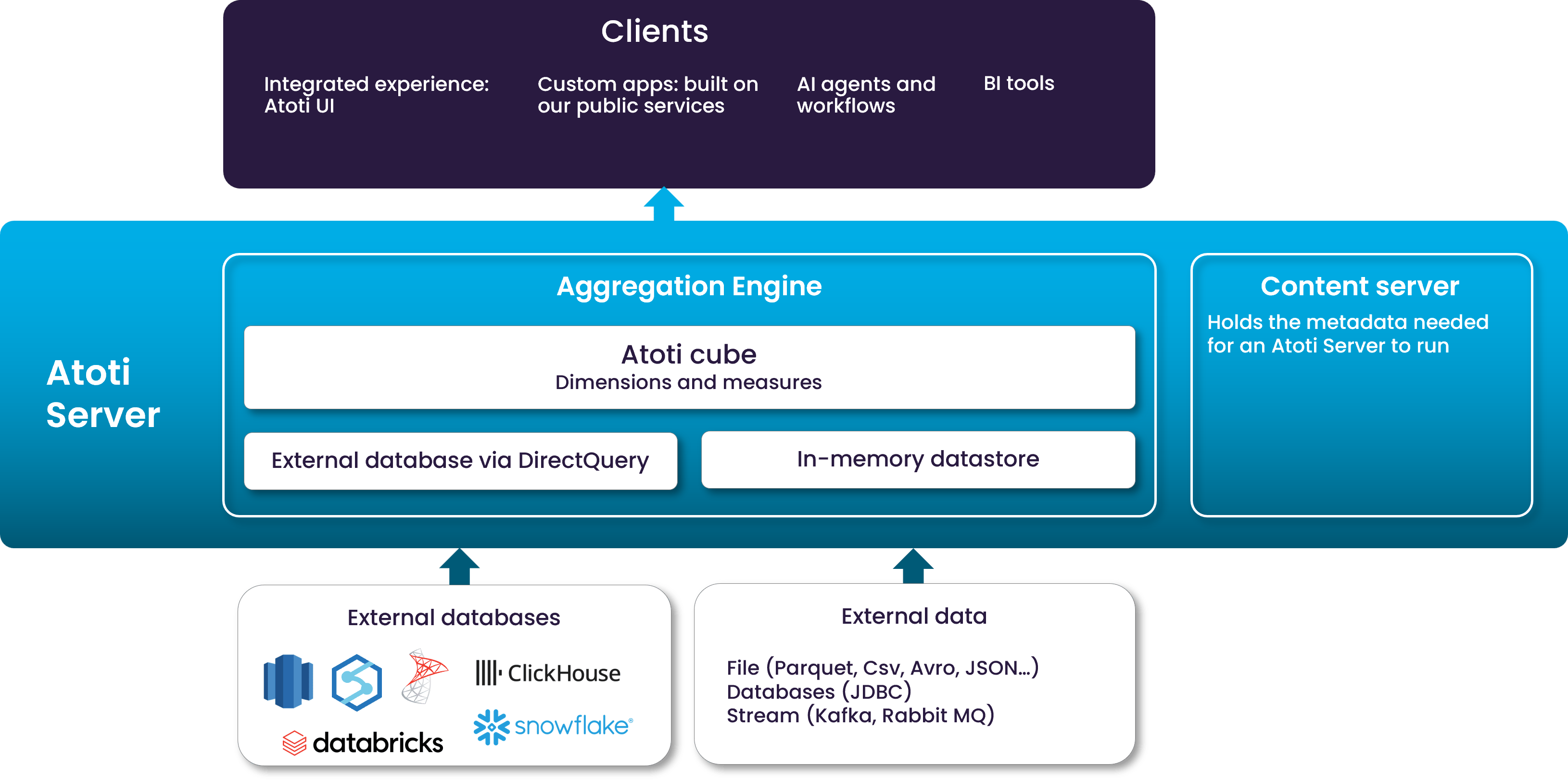
Data sources
The platform ingests data from multiple sources:- External files (Parquet, CSV, Avro, JSON, etc.)
- Databases accessed through JDBC
- Streaming systems such as Kafka or RabbitMQ
- External data warehouses such as Databricks, Snowflake, or ClickHouse
Atoti Server
At the core of the platform is the Atoti Server. It contains the aggregation engine and manages data access and calculations.Aggregation engine
The aggregation engine processes queries and computes results. At the center of the engine is the Atoti cube, which defines:- Dimensions to organize data
- Measures to calculate results
- An in-memory datastore for high-performance analytics
- External databases via DirectQuery
Content server
The content server stores the metadata required for an Atoti Server to run. This includes dashboards, measures, KPIs, and user settings. It can run embedded within Atoti Server or as a separate service.Clients and interfaces
The results of the aggregation engine are accessed through client applications. These include:- Atoti UI for an integrated analytical experience
- Custom applications built on public services
- AI agents and workflows
- Business intelligence tools (using Atoti BI Adapters)
Administration and extensibility
Atoti is an open and extensible platform. It provides:- Server management through Java.
- An Atoti Java SDK and an Atoti Python SDK.
- Deployment options for on-premise and cloud environments.
- Integration points for BI tools and custom applications.
What is Atoti Enterprise Risk?
Atoti Enterprise Risk is a complete risk analytics solution that combines the Atoti Engine, Atoti Intelligence, and Atoti solutions into a unified offering. The engine delivers consistent data modeling and aggregation, while the intelligence and solutions layers add advanced analytics capabilities and domain-specific workflows.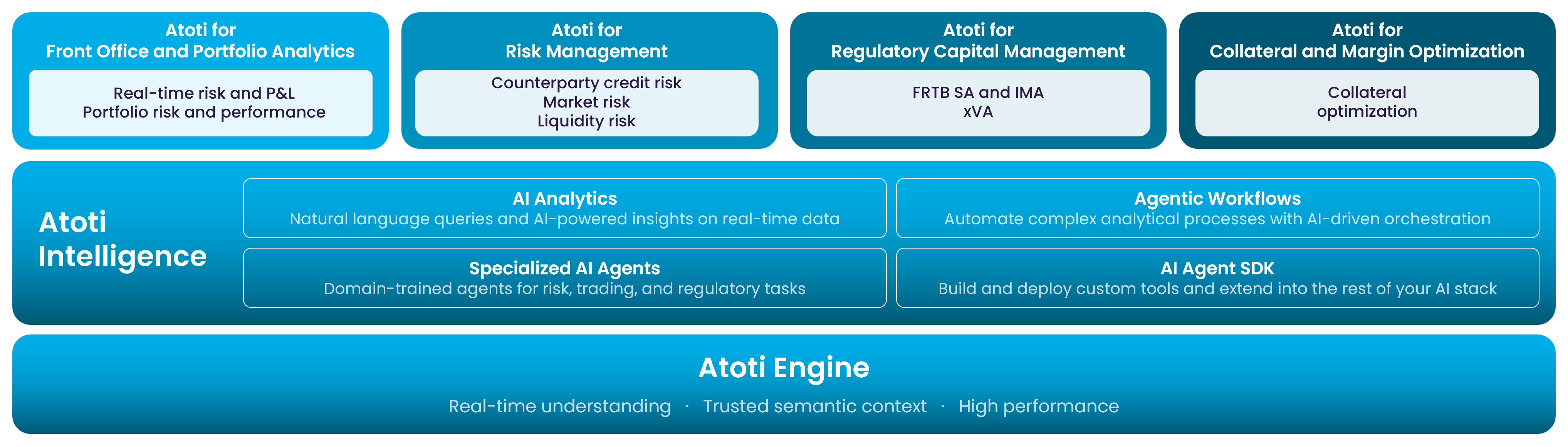
Atoti Intelligence
The intelligence layer builds on the output of the query engine and provides reusable capabilities for analytical workflows. It includes:- Atoti Intelligence, enabling AI agents to automate tasks and perform analytics
- Scenario analysis for comparing different situations
- Limits monitoring with alerts when thresholds are breached
- Sign-off workflows for controlled data updates
Atoti solutions
Atoti solutions are packaged, configurable applications that use the platform’s components and reference models. They include prebuilt semantic models, measures, calculations, and workflows. Available solutions include:- Atoti for Front Office
- Atoti for Market Risk
- Atoti for FRTB
- Atoti for xVA
- Atoti for Counterparty Credit Risk
- Atoti for Liquidity Risk
- Atoti for Collateral and Margin Optimization
Which use cases does Atoti support?
Atoti is frequently used for applications that require real time analytics or complex multidimensional calculations. Common use cases include, and are not limited to:- Real-time risk and P&L monitoring.
- Counterparty credit risk
- Liquidity risk
- Enterprise risk consolidation
- Scenario analysis and stress testing
- Regulatory capital calculation and simulation
- Collateral and margin optimization
- Portfolio and exposure analysis
- Operational workflows that require fast validation and adjustments