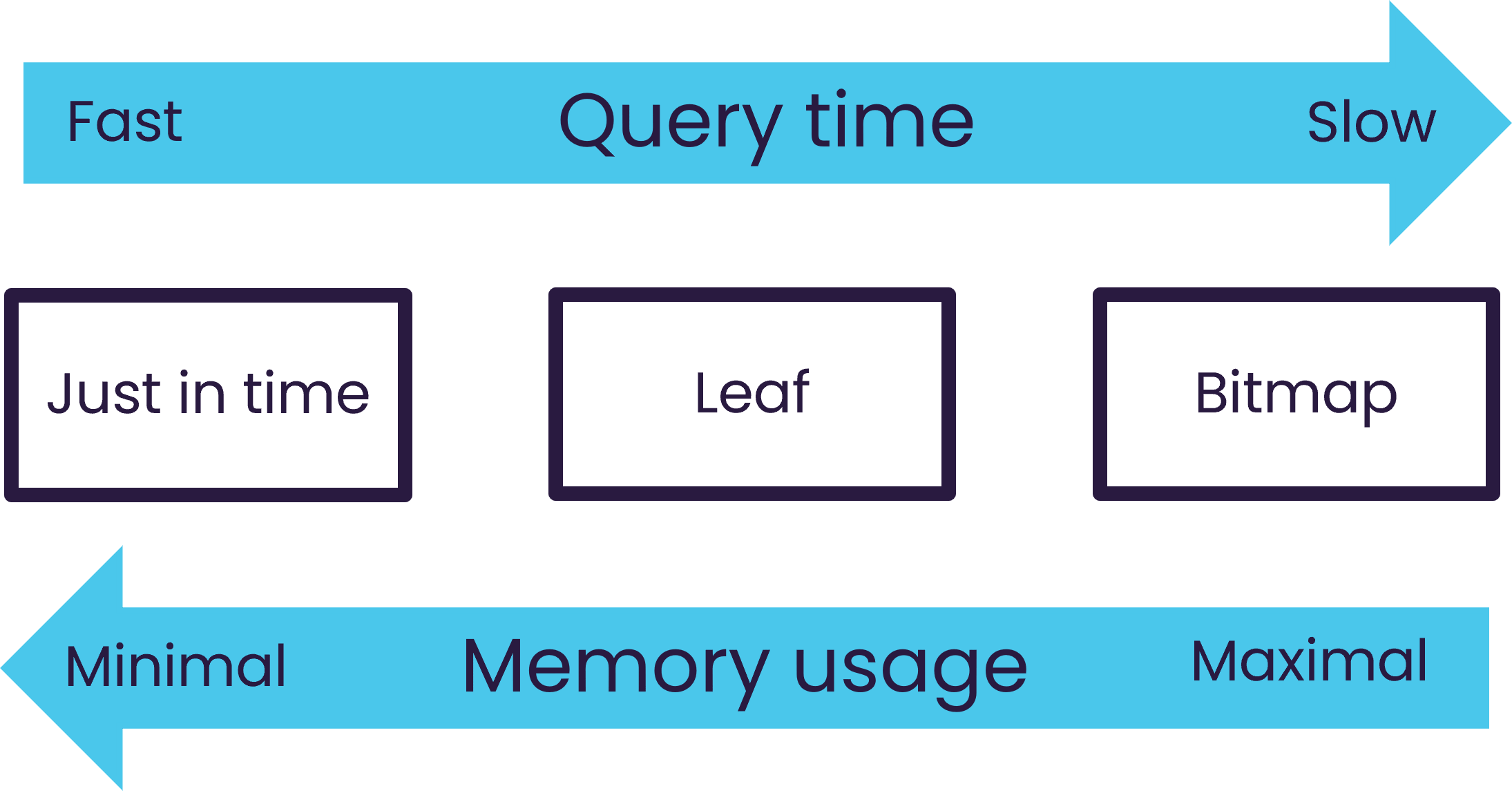

What are the types of aggregate providers and their impact?
Just-in-time (JIT) provider
- Behavior: Aggregates data at query time.
- Memory usage for storage: None.
- Memory usage at query time: Higher than other aggregate providers
- Query speed: Slower.
- Use case: Small datasets or infrequent queries.
- Impact: No pre-aggregation; queries depend on datastore scans.
Leaf provider
- Behavior: Pre-aggregates data during loading at leaf level.
- Memory usage for storage: Moderate.
- Query speed: Fast.
- Memory usage at query time: Moderate.
- Use case: Balanced performance for most cubes.
- Impact: Queries retrieve pre-aggregated values directly, reducing computation time.
Bitmap provider
A bitmap aggregate provider pre-aggregates data using a leaf provider. They use a bitmap index for faster data retrieval.- Behavior: Pre-aggregates data and builds bitmap indexes.
- Memory usage for storage: Higher than a leaf provider.
- Query speed: Fastest.
- Memory usage at query time: Lower than JIT or leaf.
- Use case: High query concurrency and large datasets.
- Impact: Queries retrieve pre-aggregated values almost instantly, even under high concurrency.