

The spreadsheet is an extension. It is not part of core Atoti UI. To get
access to it, contact your account manager. Your IT can then install
it.
The spreadsheet is a minimum viable product (MVP). It is already useful, but
it has known limitations. They will be lifted in
upcoming releases.
Spreadsheets and v2 table widgets
The spreadsheet extension adds three table widgets: Pivot table v2, Table v2 and Tree table v2. Each one appears in the widgets panel next to its standard counterpart. An orange dot marks their icons.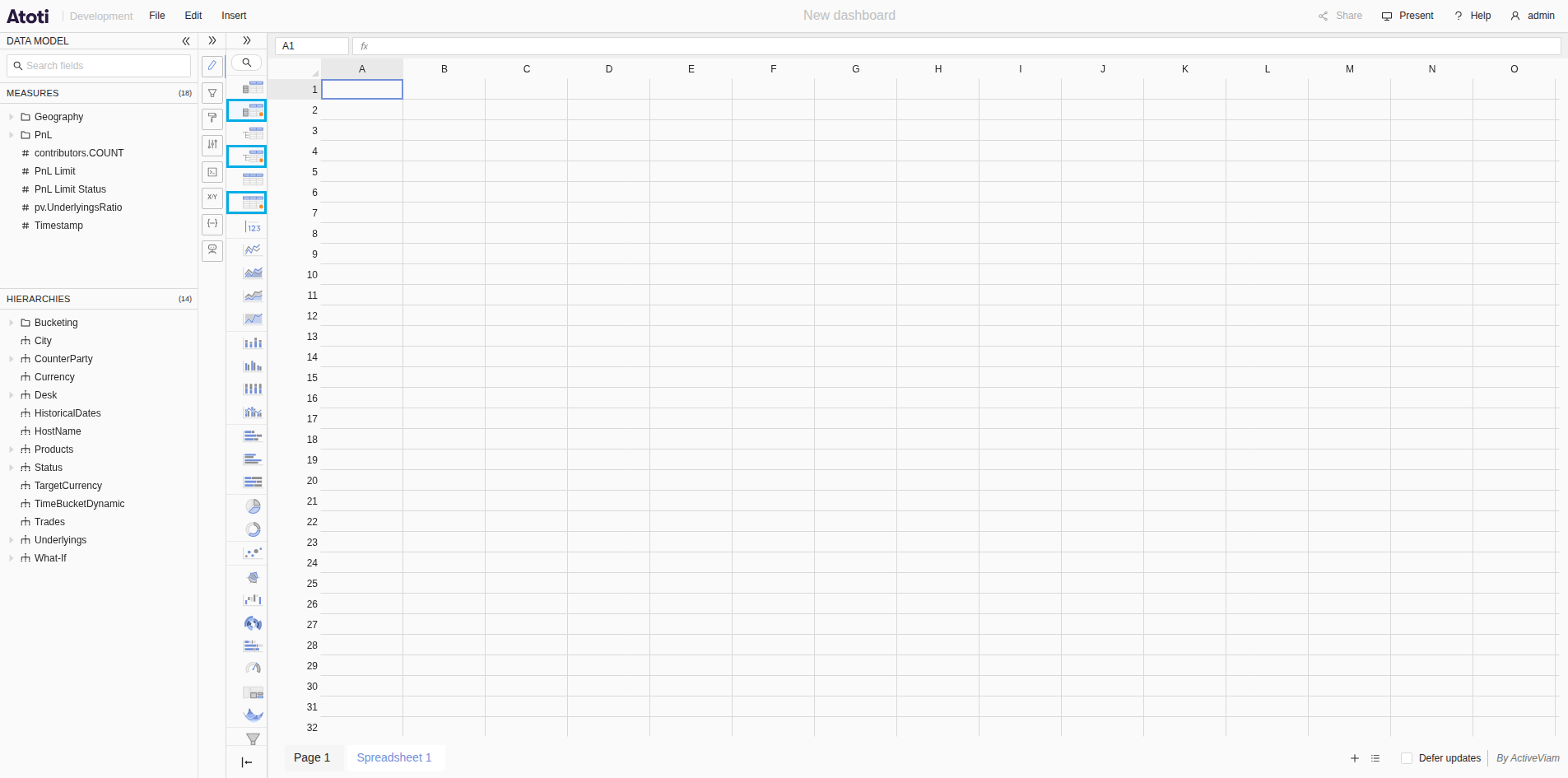
What v2 table widgets support
- Displaying the result of any MDX query.
- Drilling down members.
- Selecting cells.
- The context menu, including the menu items added by extensions.
What v2 table widgets do not support yet
- Resizing columns.
- Formatting, including number and conditional formatting.
- Reordering members by dragging and dropping them.
- Renaming members in place.
- Selection statistics.
Create a spreadsheet
- Open a dashboard.
- In the Insert menu, click New spreadsheet.
Add a widget to a spreadsheet
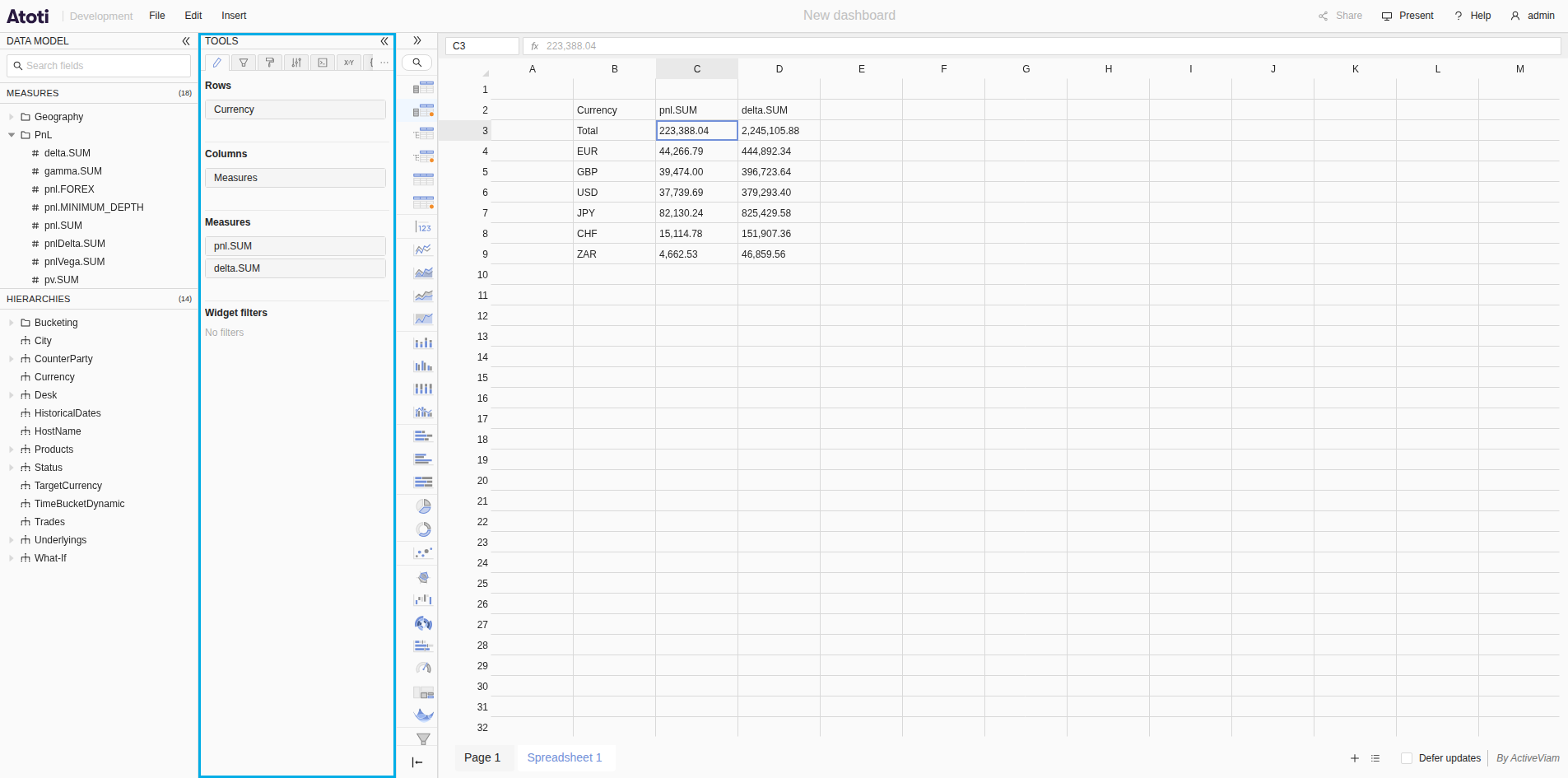
A widget in a spreadsheet is anchored at a cell: its top-left corner sits on that cell, and it covers as many cells as its data needs. All the widgets of a spreadsheet share the same grid and the same scrollbars. To add a widget:- Select an empty cell.
- In the data model, click a measure or a hierarchy.
Type values in cells
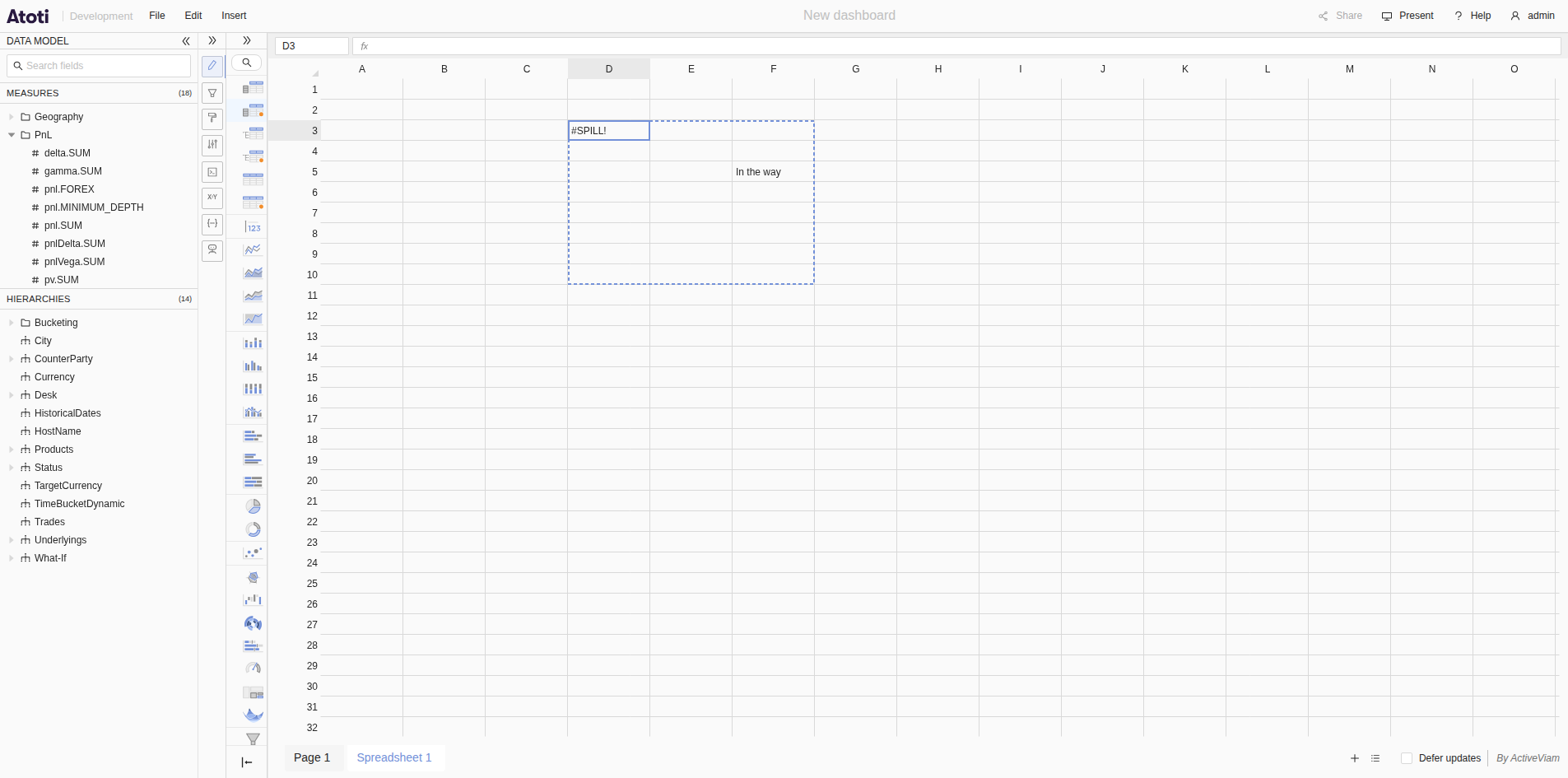
Type a number or some text in any cell that no widget covers.- To replace the content of a cell, select it and start typing.
- To edit the content of a cell, double-click it or press F2.
- To validate, press Enter or Tab, or click outside the grid.
- To cancel, press Escape.
- To clear the selected cells, press Delete.
Write a formula
A formula starts with=.
It combines numbers and cell references with the operators +, -, * and /.
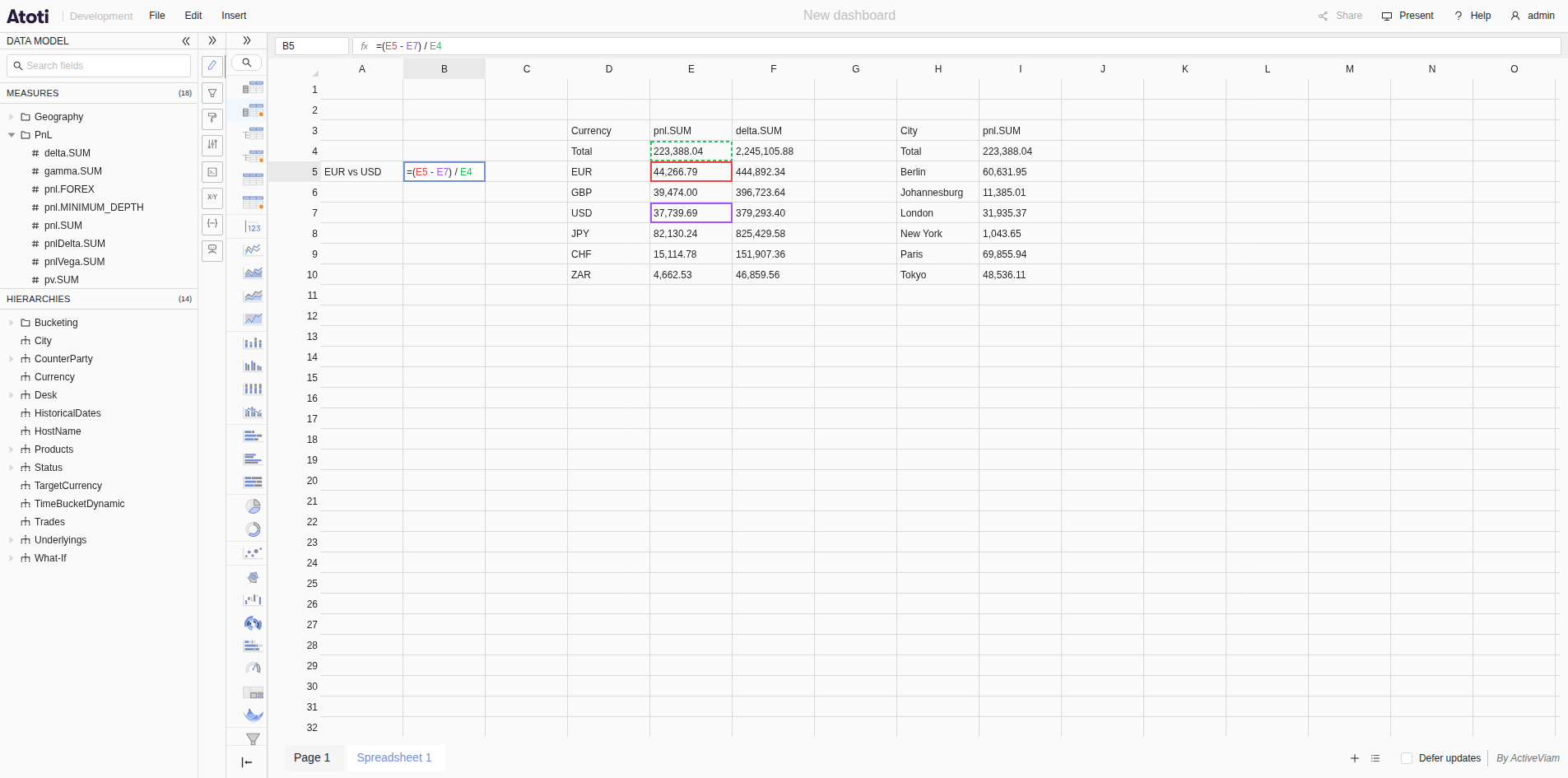
You can use parentheses to group operations, for example =(I6 - H6) / G18.
The formula bar sits above the page.
On its left, the name box shows the address of the selected cell, for example B5.
The formula bar shows the content of the selected cell.
For a formula cell, it shows the formula, and the cell shows its result.
To write a formula:
- Select the cell that will hold the result.
- Click the formula bar. You can also type directly in the cell.
- Type
=. - Click the cell you want to reference. Its reference appears in the formula.
- Type an operator, such as
-. - Click another cell to reference it.
- Repeat steps 5 and 6 as needed.
Type
(and)wherever you need them. - Press Enter.
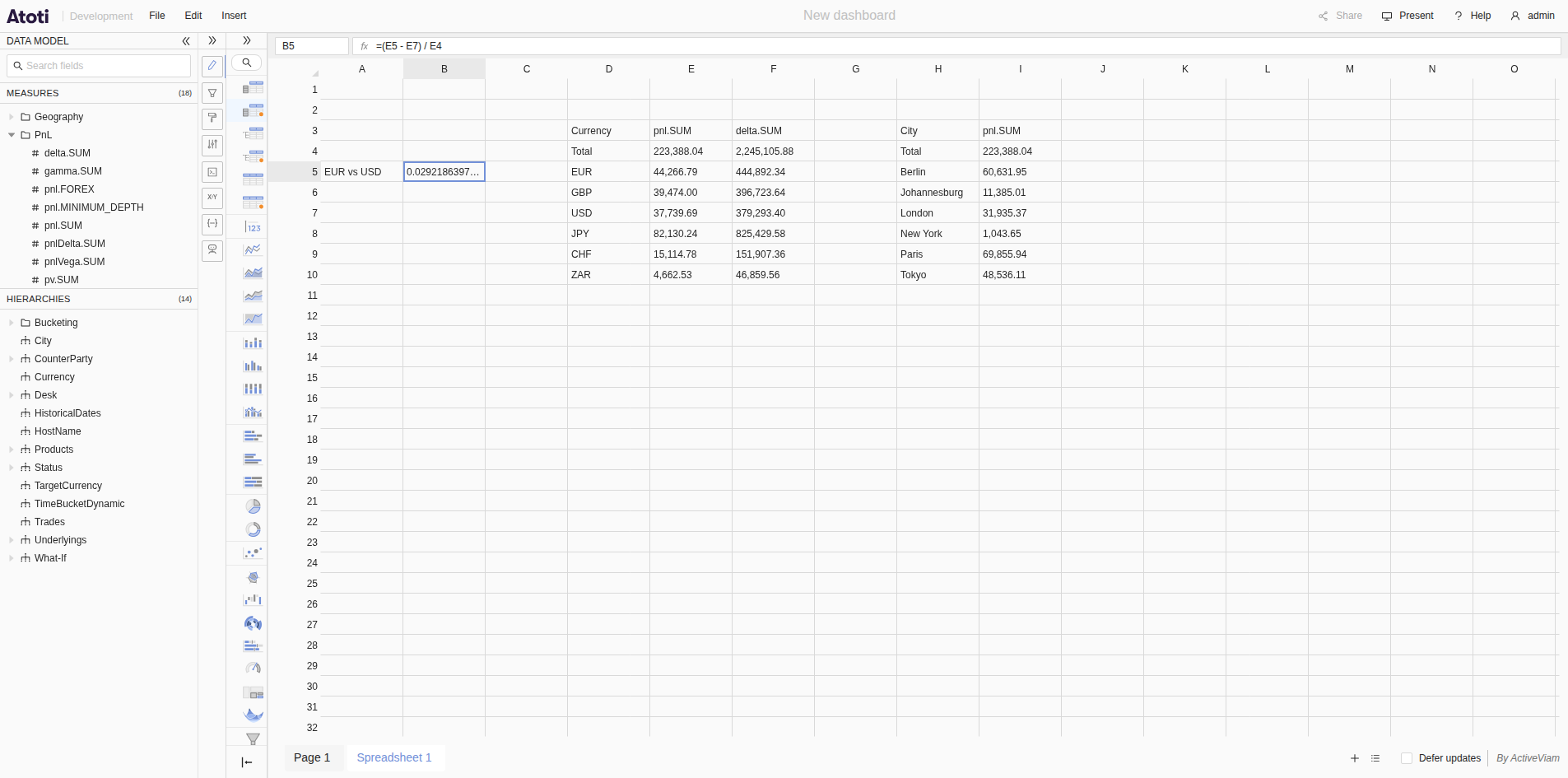
Reference cells by clicking them
While you write a formula, you can click a cell instead of typing its address. This works wherever the formula expects a value: right after=, an operator, or (.
- Click a cell to insert its reference.
- Click another cell to replace the reference you just inserted.
- Use the arrow keys to move the reference to a neighboring cell.
- Type an operator or a parenthesis to keep the reference and continue the formula.
=B2 * 2.
Reference a cell of a widget
You can reference a cell of a v2 table widget the same way as any other cell: click it while you write the formula.- If the widget is anchored in the spreadsheet you are editing, the reference is the address of the cell in the spreadsheet, for example
D5. - If the widget is on another page, the reference points to the cell in the widget’s own grid, for example
'p-2/0'!C7.
Reference a cell on another page
A formula can reference cells on any page of the same dashboard: another spreadsheet, or a regular page containing v2 table widgets.- Start writing the formula, and stop where you want the reference, for example after
=or+. - Click the tab of the other page at the bottom of the dashboard. The formula stays in edit mode, and you keep typing in the formula bar.
- Click the cell you want to reference. Atoti UI writes the reference to that cell.
- Continue the formula. To reference cells from other pages, click their page tabs.
- Press Enter.
!, for example 'p-2'!C7.
- For a cell of another spreadsheet, the identifier is the key of its page, for example
'p-2'!C7. - For a cell of a v2 table widget, the identifier combines the key of its page and the key of the widget, for example
'p-2/0'!C7.
Page keys are internal identifiers. They differ from the page names shown in
the page tabs. Click cells to write references to other pages rather than
typing them.
Formula results and updates
A formula recomputes when a cell it references changes. This includes widget cells that change after a query update, or through a live update.- An empty referenced cell counts as
0. - A formula can reference other formula cells.
If you validate a formula with a syntax error, for example
=A1 +, Atoti UI rejects it and the cell keeps its previous content.
Current limitations
The spreadsheet is a minimum viable product (MVP). It has the limitations below, which upcoming releases will lift. Formulas support only the operators+, -, * and /, and parentheses.
They do not support yet:
- Functions, such as
SUM,AVERAGE,VLOOKUPorIIF. - Ranges, such as
A1:A10. - Absolute references, such as
$A$1. - References that follow a member. A reference to a widget cell points to a position in the widget, not to a member. When the layout of the widget changes, for example after a drilldown, a sort or a new member arriving through a live update, the formula reads the cell now at that position.
- Extending a formula to neighboring cells, for example by dragging it.
- Resizing its columns.
- Inserting or deleting rows and columns.
- Formatting cells, including the results of formulas. For example, a result shows all its decimals.
- Copying, cutting and pasting cells.
Out of scope
The spreadsheet brings Excel-like flexibility to the data of the cube. It does not aim to replace Excel. The following will not be supported:- Excel plugins, such as the Bloomberg Excel add-in.
- VBA macros.
- References to cells of standard table widgets. v2 table widgets will ultimately replace them.