Contributory measures are used by Risk Managers to analyze the impact of a Sub-Portfolio on the Value at Risk of the total Portfolio. These measures can help…
Use this file to discover all available pages before exploring further.
Contributory measures are used by Risk Managers to analyze the impact of
a Sub-Portfolio on the Value at Risk of the total Portfolio. These
measures can help to track down individual trades that have significant
effects on VaR. Furthermore, contributory measures can be a useful tool
in hypothetical analyses of portfolio development versus VaR
development.
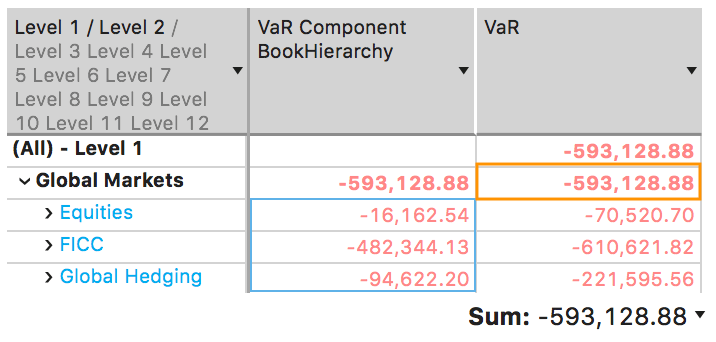
In the below screenshot you can see a pivot table, displaying VaR and VaR Component BookHierarchy. The total of the Component VaR for the sub portfolios under the “Global Markets” node is equal to the VaR value computed for the “Global Markets”.
The Component VaR of Sub-Portfolio x measures the rate of change of the
VaR of Portfolio X with respect to an incremental change in the size of
Sub-Portfolio x.CoVaRx=∂wx∂VaR(X)where wx is the weight of Sub- Portfolio x in Portfolio X.Component VaR is a very useful tool to examine the overall impact of
local changes in a Sub-Portfolio upon the total Portfolio. It is an
additive measure so that the Component VaRs of all Sub-Portfolios add up
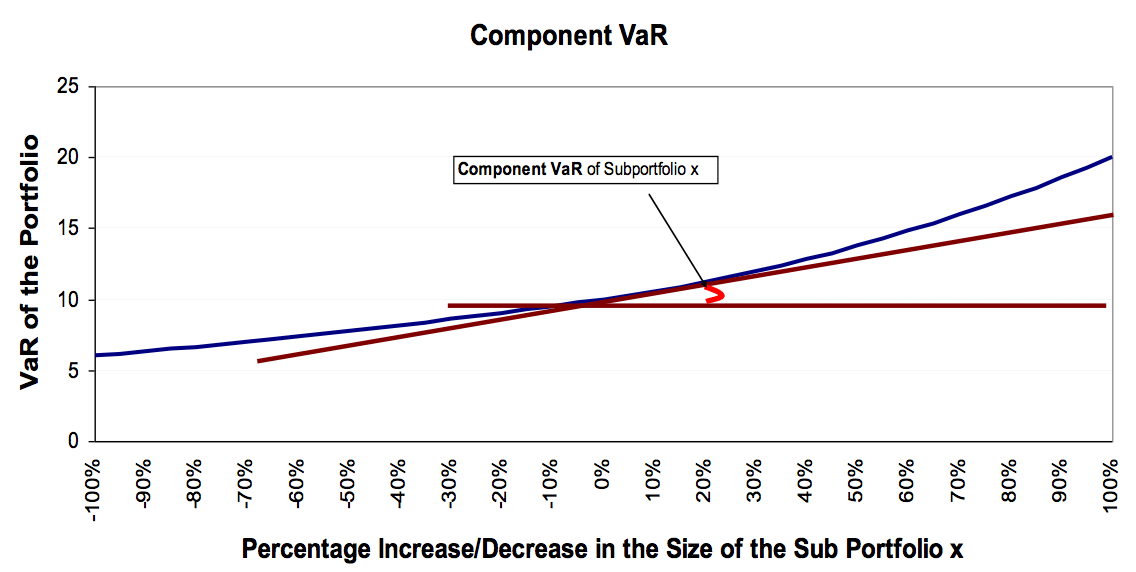
to the VaR of the total Portfolio.In the Figure below, the CoVaR equals to the slope of the tangent line at point (VaRwx, wx+0%⋅wx).
For a parent portfolio X with N components Y1, Y2, …, YN the algorithm1 to
compute CoVaRs is:Regress:Y=a+b⋅X+c⋅X2Calculate:A=L∑x∑x2∑x∑x2∑x3∑x2∑x3∑x4→A−1A−1 - getting the inverse matrix.Start Loop: For i = 1 to N:
Calculate:
Bi=∑yi∑xyi∑yix2
Multiply:
A−1⋅Bi=abcto get a, b, c the parameters of the regression.
Compute:
CoVaRi=−[a+b⋅(−VaR)+c⋅VaR2]
Compute:
CoVaRipercentage=VaR−[a+b⋅(−VaR)+c⋅VaR2]End Loop: Next iAll sums, within matrices A and B, span for “ranked” vector scenario ids starting from 1 up to L, with 1 the most negative PnL value for the parent portfolio.For example:j∑x2=x12+x22+⋯+xL2j∑xyi=x1yi1+x2yi2+⋯+xLyiLwhere xj is the jth PnL of the “ranked” parent portfolio scenario ids and yij is its ith component’s PnL value on jth scenario id.L denotes the number of scenario ids included in the regression.
The Delta Component VaR of Sub-Portfolio x measures the rate of change
of a Portfolio’s daily change in VaR (Delta VaR(X)) with respect to an
incremental change in a Sub-Portfolio’s daily change in size (Delta wx).The Delta Component VaR is a very useful tool to examine the overall
impact of local changes in a Sub-Portfolio upon the total Portfolio’s
daily changes in VaR. Delta Component VaR is an additive measure so that
the Delta Component VaRs of all Sub Portfolios add up to the daily
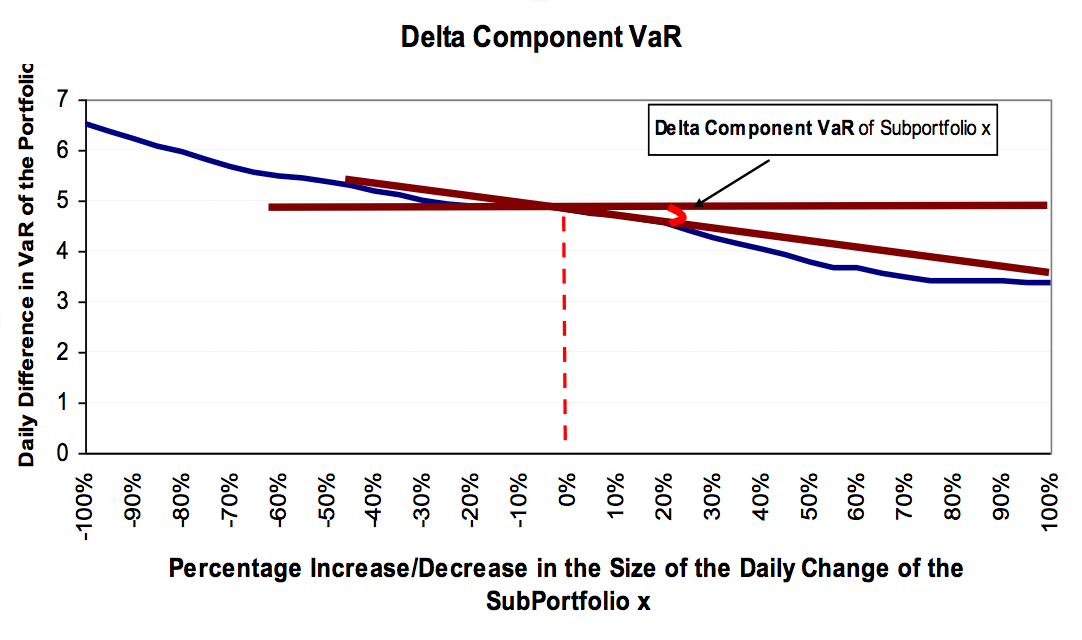
change in VaR of the total Portfolio.ΔCoVaRx=∂(Δwx)∂(ΔVaR(X))In the Figure below, CoVaR equals to the slope of the tangent line at point (ΔVaR, Δwx+0%⋅Δwx).
Delta Component VaR or Delta CoVaR will be computed in the same fashion as
the CoVaR by using the quadratic regression technique.For a parent portfolio X with N components Y1, Y2, …, YN the algorithm1 to compute DeltaCoVaRs is:Calculate:A=L∑Δx∑Δx2∑Δx∑Δx2∑Δx3∑Δx2∑Δx3∑Δx4→A−1A−1 - getting the inverse matrix.Start Loop: For i = 1 to N;
Calculate:
Bi=∑Δyi∑ΔxΔyi∑ΔyiΔx2
Multiply:
A−1⋅Bi=abcto get a, b, c the parameters of the regression.
Compute:
ΔCoVaRi=−[a+b⋅(−ΔVaR)+c⋅ΔVaR2]
Compute:
ΔCoVaRipercentage=ΔVaR−[a+b⋅(−ΔVaR)+c⋅ΔVaR2]End Loop: Next iThe PnL vector inputs for the parent portfolio X with N components Y1, Y2, …, YN are now equal to the daily PnL changes from one business date to the next business date.The changes of the parent portfolio are related to the changes to its N components with the following equations:xicob−xicob−1=(y1icob−y1icob−1)+(y2icob−y2icob−1)+⋯+(yNicob−yNicob−1), for i=1 to 500where xi is the most backdated PnL date at cob for parent portfolio X.All sums, within matrices A and B, span for “ranked” vector scenario ids starting from 1 up to L, with 1 the most negative PnL value for the parent portfolio.For example, ∑jΔx2=Δx12+Δx22+⋯+ΔxL2 and ∑jΔxΔyi=Δx1Δyi1+Δx2Δyi2+⋯+ΔxLΔyiL, where Δxj is the daily change of the jth PnL of the “ranked” parent portfolio scenario ids and Δyij its ith component’s PnL value on jth scenario id.ΔVaR is the change in VaR of the parent node from cob to cob-1.L denotes the number of scenario ids included in the regression.
Here is the algebraic solution for the a, b, c.a=n∑x2−(∑x)2∑y∑x2−∑xy∑x+c∑x3∑x−c(∑x2)2b=n∑x2−(∑x)2n∑xy−nc∑x3+c∑x2∑x−∑y∑xc=2∑x3∑x∑x2−(∑x2)3−n(∑x3)2+∑x4(n∑x2−(∑x)2)(∑x2y)(n∑x2−(∑x)2)−(∑x2)2∑y+∑xy∑x∑x2+2∑x3∑x∑x2−(∑x2)3−n(∑x3)2+∑x4(n∑x2−(∑x)2)−n∑x3∑xy+∑y∑x∑x3
The regression parameters a, b, c can also be computed
algebraically. See Algebraic solution. ↩︎