Database API
An Atoti cube can work on top of a Datastore or an external data warehouse.
Therefore, a common interface is used to represent any component capable of providing versioned data for the cube.
This interface is com.activeviam.database.api.IDatabase.
This interface has two kind of implementations:
IDatastorewhich is the Atoti implementation of an in-memory database.IDirectQueryDatabasewhich is an implementation that supports querying an external data warehouse.
An Atoti cube can use any IDatabase as a data provider.
Database Schema
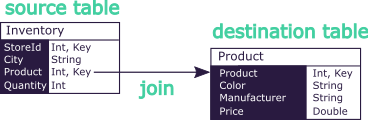
The database schema consists of a set of tables, each containing fields, and that are interlinked with joins.
For those used to the vocabulary historically used in the Datastore, the tables used to be called stores, and the joins
used to be called references.
Naming joins is not something that exists in common databases.
In the context of Atoti where it is mandatory to pre-define a flattened schema, it is convenient to assign names to
those paths. This makes it easier to reason about those fields as integrated to the schema.
Versions
Atoti Databases have the same concept of versions and branches that were previously exposed by the Datastore and Atoti cubes. As before, they represent single points in time of the Database and alternative scenarios on the dataset.
Query Runner
This component is accessed from a Version through the method IDatabaseVersion#getQueryRunner.
The Query Runner is the entry-point to run queries on a Database. It can run different types of queries:
- List: These queries are made to retrieve a list of records that match some specified conditions.
- Get-By-Key: These queries are made to retrieve one or several records (lines of data in a table) given their unique identifier (i.e. the key).
- Distinct: These queries are made to retrieve distinct values of a field or a field combination from a list of records. The list of records can be optionally filtered with specified conditions.
- Statistics: These queries are made to retrieve information about the Database. Details like the size of a table, or the cardinality of a given field.
Query Manager
This component is accessed from a Version through the method IDatabaseVersion#getQueryManager or from the database
itself.
Completing the Query Runner, the Query Manager makes it possible to prepare queries beforehand.
Using an analogy with JDBC, the Query Runner creates an SQL Statement while the Query Manager creates Prepared
Statements. In the language of the QueryManager, it produces instances of IPreparedQuery
The benefits of Prepared Queries include compiling-once, managing, parametrizing and reusing them.
Once created, those queries must be passed to a given Query Runner to be executed in a given version.
See Database Queries for detailed examples of building and running queries.
Data Streamer
This component is accessed from the database through the method IDatabase#getDataStreamer.
The data streamer provides push-based notifications of data changes. Instead of polling, register a query and a listener: the streamer calls the listener whenever a transaction affects the query results.
Registering a stream view
Registering a stream view requires three things:
- An
IPreparedListQuerydefining what data to watch (see Database Queries for how to build list queries) - An
IStreamListViewListenerthat receives change notifications RegistrationOptionsto configure the streaming behavior
// 1. Prepare the query
final IPreparedListQuery query =
    database
        .getQueryManager()
        .listQuery()
        .forTable("trades")
        .withCondition(BaseConditions.equal(FieldPath.of("city"), "Paris"))
        .withTableFields("tradeId", "trader", "value")
        .compile();
// 2. Create the listener
final IStreamListViewListener listener = new TradeStreamListener();
// 3. Register on the data streamer
final IStreamedViewListenerRegistration registration =
    database
        .getDataStreamer()
        .registerListStreamView(query, listener, RegistrationOptions.defaults());
// 4. Wait for the registration to complete (including initial view if enabled)
registration.getAttachmentProcess().toCompletableFuture().get();
// ... the listener is now receiving updates on every commit ...
// 5. Unregister when done
registration.unregister();
The stream view listener
The IStreamListViewListener interface defines callbacks for each type of data change.
Some callbacks may be invoked concurrently (e.g. for different partitions), so listener implementations must be
thread-safe.
Within a transaction, callbacks are called in this order:
transactionStartedsignals the beginning of a commit- Record change callbacks:
recordsAdded,recordsDeleted,recordsUpdated,partitionDropped, ortruncate transactionCommittedortransactionRolledBacksignals the outcome
If any callback throws an exception, it is captured and passed to onSelfFailure.
The IRecordBlock and IRecordReader instances passed to listener callbacks may be backed by reused internal buffers.
To keep the data beyond the callback invocation, it must be cloned (e.g. using IRecordReader#toList() or
IRecordReader#copy()).
static class TradeStreamListener implements IStreamListViewListener {
  // Thread-safe collection: callbacks may be invoked concurrently for different partitions
  private final Queue<List<Object>> receivedRecords = new ConcurrentLinkedQueue<>();
  @Override
  public void transactionStarted(final IEpoch epoch, final ITransactionInformation info) {
    // Called at the beginning of a commit
  }
  @Override
  public void transactionCommitted(final IEpoch epoch) {
    // Called after the transaction successfully commits
  }
  @Override
  public void transactionRolledBack() {
    // Called if the transaction rolls back
  }
  @Override
  public void recordsAdded(
      final int partitionId, final IRecordBlock<? extends IRecordReader> records) {
    // Important: record data may be backed by a reused buffer
    // Clone the data if you need to keep it beyond this callback
    for (final IRecordReader r : records) {
      this.receivedRecords.add(r.toList());
    }
  }
  @Override
  public void recordsDeleted(
      final int partitionId, final IRecordBlock<? extends IRecordReader> records) {
    // Handle deleted records
  }
  @Override
  public void recordsUpdated(
      final int partitionId,
      final IRecordBlock<? extends IRecordReader> oldValues,
      final IRecordBlock<? extends IRecordReader> newValues) {
    // Handle updated records — both old and new values are provided
  }
  @Override
  public void partitionDropped(
      final int partitionId,
      final List<int[]> dropConditionsFields,
      final IRecordBlock<? extends IRecordReader> records) {
    // Handle dropped partitions
  }
  @Override
  public void truncate() {
    // Handle truncation (all data removed)
    this.receivedRecords.clear();
  }
  @Override
  public void onSelfFailure(final Throwable error) {
    // Called if any of the above callbacks throws an exception
  }
}
Registration options
RegistrationOptions is configured with a builder:
| Option | Default | Description |
|---|---|---|
sendInitialView | true | Sends the current data snapshot to the listener before streaming deltas. |
branch | null | Branch to listen to. null receives updates from all branches. |
dictionarized | false | Whether dictionarized field values are streamed in their encoded form. |
final RegistrationOptions options =
    RegistrationOptions.builder()
        .sendInitialView(true) // send a snapshot of current data before streaming deltas
        .branch(IEpoch.MASTER_BRANCH_NAME) // only listen to changes on the master branch
        .dictionarized(false) // receive plain values, not dictionary-encoded
        .build();
When sendInitialView is enabled, the streamer must catch up with the current state of the datastore before streaming
deltas. How this catch-up works depends on the branch option:
- Single-branch (
branchset to a specific branch): the catch-up runs asynchronously. Transactions on the datastore are not blocked. - Multi-branch (
branchset tonull): the catch-up runs synchronously inside a maintenance operation, blocking all transactions until the initial view is fully delivered.
Always prefer setting a specific branch when possible. Even if the application only uses the master branch, explicitly setting it avoids blocking transactions during the catch-up phase.
This distinction only applies to the Datastore. DirectQuery databases only operate on the master branch.
Managing the registration
registerListStreamView returns an IStreamedViewListenerRegistration to manage the lifecycle of the stream:
getAttachmentProcess()returns aCompletionStage<Void>that completes once the listener is fully registered. IfsendInitialViewis enabled, it completes after the initial data snapshot has been delivered.unregister()removes the listener and frees internal resources. If no more listeners remain for the underlying view, the view itself is deleted.