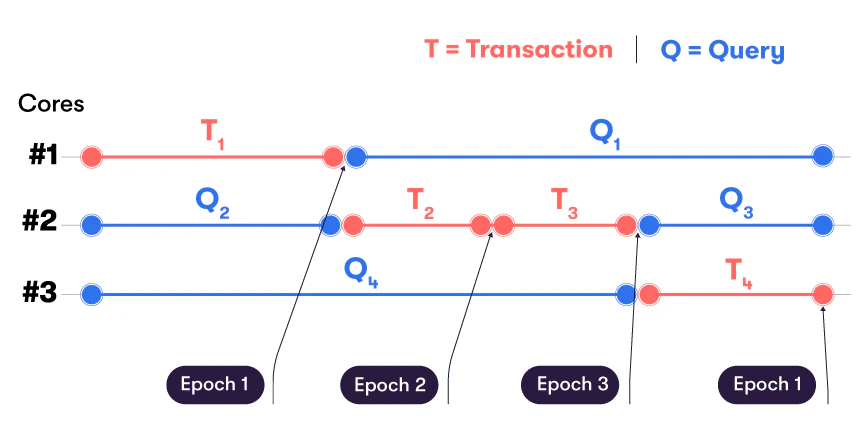
 The Epoch Counter is set to 0 at system startup. A timestamp is recorded for Epoch 0.
The Epoch Counter is incremented whenever a transaction is committed to the Datastore.
The Epoch Counter (otherwise known as Epoch Id) becomes the new version number for the Datastore.
For each new epoch, a new timestamp is also recorded.
## Versions
> An `IVersion` (or version) in Atoti corresponds to the state of a multi-versioned component for a given `IEpoch`.
Every committed transaction implies a new version of the Datastore. However, for each epoch, depending on the nature of
the transaction, other multi-versioned components may or may not hold a version associated to this epoch.
### Example
Let's consider the following example: within the Datastore, there are two stores, the Risk store and the Forex store.
No data from the Forex Store is ever used within the Cube.
The Forex Store exists purely to provide parameters for post-processing. It does not contribute to any pivot tables.
The Risk Store is the base store within the Datastore and there are no references between the Risk Store and the Forex
store.
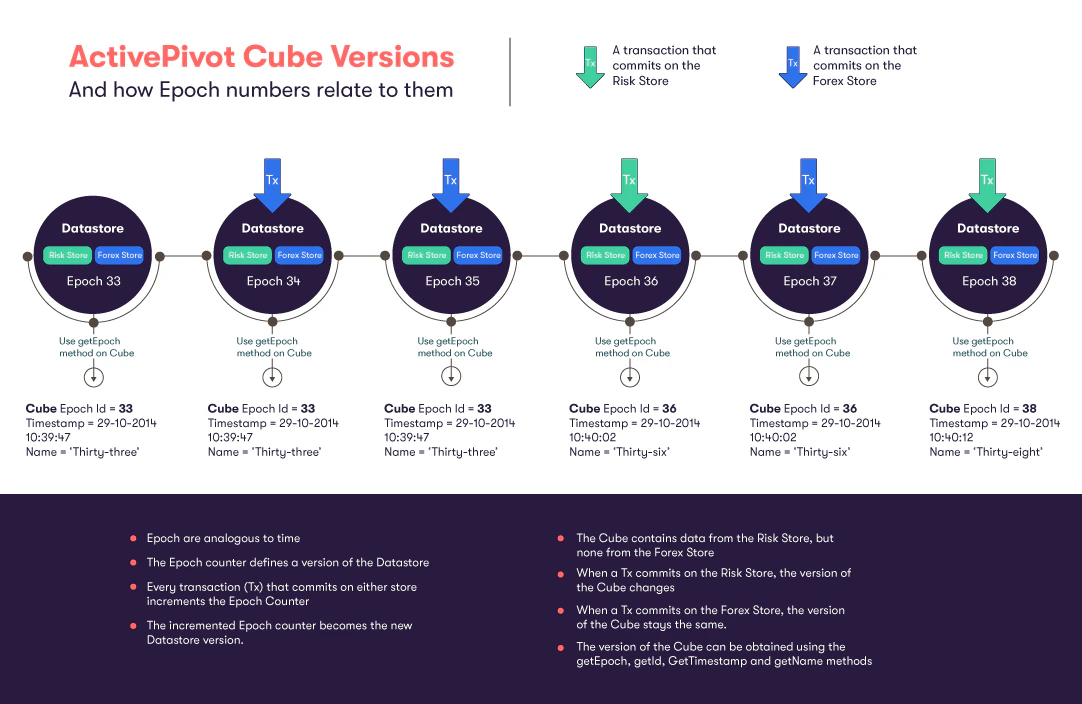
When a transaction commits in the Forex Store, no new `IActivePivotVersion` will be created, because the cube is not
directly affected by anything in the Forex store.
So a new version of the Datastore will be created (with an incremented Epoch Counter as its Id),
but **NOT** a new `IActivePivotVersion`.
The `IActivePivotVersion` is associated with an Epoch, but not necessarily the same one as the latest version of the
Datastore.
The Epoch of any version can be found by using the `getEpoch()` method of the `IVersion` interface.
> Note about `IActivePivotVersion`s: each time an `IActivePivotVersion` is created, a new instance of the Aggregates
> Cache and Post-processors defined in the cube are associated with the new version.
The illustration below shows transactions committing on either the Risk Store or the Forex store for the presented
example:
The Epoch Counter is set to 0 at system startup. A timestamp is recorded for Epoch 0.
The Epoch Counter is incremented whenever a transaction is committed to the Datastore.
The Epoch Counter (otherwise known as Epoch Id) becomes the new version number for the Datastore.
For each new epoch, a new timestamp is also recorded.
## Versions
> An `IVersion` (or version) in Atoti corresponds to the state of a multi-versioned component for a given `IEpoch`.
Every committed transaction implies a new version of the Datastore. However, for each epoch, depending on the nature of
the transaction, other multi-versioned components may or may not hold a version associated to this epoch.
### Example
Let's consider the following example: within the Datastore, there are two stores, the Risk store and the Forex store.
No data from the Forex Store is ever used within the Cube.
The Forex Store exists purely to provide parameters for post-processing. It does not contribute to any pivot tables.
The Risk Store is the base store within the Datastore and there are no references between the Risk Store and the Forex
store.
When a transaction commits in the Forex Store, no new `IActivePivotVersion` will be created, because the cube is not
directly affected by anything in the Forex store.
So a new version of the Datastore will be created (with an incremented Epoch Counter as its Id),
but **NOT** a new `IActivePivotVersion`.
The `IActivePivotVersion` is associated with an Epoch, but not necessarily the same one as the latest version of the
Datastore.
The Epoch of any version can be found by using the `getEpoch()` method of the `IVersion` interface.
> Note about `IActivePivotVersion`s: each time an `IActivePivotVersion` is created, a new instance of the Aggregates
> Cache and Post-processors defined in the cube are associated with the new version.
The illustration below shows transactions committing on either the Risk Store or the Forex store for the presented
example:
 ## Epoch management
As long as an epoch is considered valid, all corresponding versions will be kept by their respective multi-versioned
components. This automatically implies a memory cost (and the potential performance cost) of keeping multiple epochs and
their associated versions.
Epochs that are no longer needed can be released, meaning that the corresponding versions may be discarded and garbage
collected. Released epochs are no longer accessible for queries.
### Epoch management policy
The epoch manager and its `IEpochManagementPolicy` are defined when building the application:
```java theme={"languages":{"custom":["/engine/python-sdk/0.9/languages/pycon.tmLanguage.json"]}}
StartBuilding.application().withEpochPolicy(IEpochManagementPolicy policy);
```
The default `IEpochManagementPolicy` is the `KeepLastEpochPolicy`, which is a policy that keeps only the latest few
epochs, according to creation time criteria and/or number of epochs criteria. It guarantees to keep the heads of all
defined branches.
The default configuration of this epoch policy implies that old epochs may only be discarded when a commit happens or
when a garbage collection cycle is triggered by the JVM.
This can however be customized further:
```java theme={"languages":{"custom":["/engine/python-sdk/0.9/languages/pycon.tmLanguage.json"]}}
application.withEpochPolicy(
new KeepLastEpochPolicy().setEpochsToKeep(20).setTimeToKeep(Duration.ofSeconds(5)));
```
will force the application to keep at least the 20 latest epochs and at least 5 seconds of history.
Alternatively, the `KeepAllEpochPolicy` can be used to retain all epochs for the entire lifetime of the application.
### Inspecting epochs
Since the Epoch counter is incremented each time a transaction is committed, it may be hard to track which epochs are
available on a running Atoti application.
The epoch manager is responsible for applying the `IEpochManagementPolicy` on the application during its lifespan.
Release of old epochs is performed automatically according to the policy, or can be performed manually through MBeans
in `com.activeviam > Datastore > Epoch Manager` (releasing epochs, dropping branches, listing existing branches).
The same operations are available programmatically via the `IEpochManager` interface.
The `IDatabase` interface provides methods to access non-released versions:
* `getMasterHead()` returns the latest version on the master branch
* `getHead(String branchName)` returns the latest version on a specific branch
* `getVersion(long epochId)` returns the version at a specific valid epoch
More methods to access past versions can be found in `IVersionHistory` interface.
The `getEpochsUsage` operation, available in the Epoch Manager MBean, provides statistics about the versions held by
each multi-versioned component of the application as well as the released and discarded epochs.
### Querying a specific version
Each `IDatabaseVersion` provides a `getQueryRunner()` method to execute queries on that version of the data.
Queries performed on this `IQueryRunner` interface will return data corresponding to facts as-of the corresponding
epoch.
The [Epoch Dimension](#epoch-dimension) is available when performing **MDX Queries** and allows for complex cross-epoch
calculations.
## Branches
> Branches allow the user to efficiently maintain several states of the data.
> This feature is most often used to perform a simulation without affecting the real data.
> A user can thus study the impact of a change without affecting the data used in other branches,
> such as the one used in production.
The concept of "What-if" is the idea of performing a business-related Projection or Simulation
that does not alter the main dataset.
There are several ways to perform "What-If" analysis in Atoti:
the use of branches is especially flexible and straightforward from a user standpoint.
It is possible to perform a memory-efficient modification of the dataset on a new branch,
investigate that scenario, then return to the `master` branch to leave the scenario.
The branch created for the scenario can be deleted after use, or it can be kept for future reference
and further modifications. Branch-specific security implies that a branch can be personal to the one testing a scenario,
or shared among a team as needed.
In practice every transaction is made on some branch, which is assumed to be "master" if unspecified.
A branch can therefore be represented by the set of the transactions done on it.
### How branches differ from Git
Git's implementation of a versioned system is remarkably well-known amongst developers.
It uses two dimensions for navigation: the first one holds the branches while the second one represents time,
the succession of actions performed.
## Epoch management
As long as an epoch is considered valid, all corresponding versions will be kept by their respective multi-versioned
components. This automatically implies a memory cost (and the potential performance cost) of keeping multiple epochs and
their associated versions.
Epochs that are no longer needed can be released, meaning that the corresponding versions may be discarded and garbage
collected. Released epochs are no longer accessible for queries.
### Epoch management policy
The epoch manager and its `IEpochManagementPolicy` are defined when building the application:
```java theme={"languages":{"custom":["/engine/python-sdk/0.9/languages/pycon.tmLanguage.json"]}}
StartBuilding.application().withEpochPolicy(IEpochManagementPolicy policy);
```
The default `IEpochManagementPolicy` is the `KeepLastEpochPolicy`, which is a policy that keeps only the latest few
epochs, according to creation time criteria and/or number of epochs criteria. It guarantees to keep the heads of all
defined branches.
The default configuration of this epoch policy implies that old epochs may only be discarded when a commit happens or
when a garbage collection cycle is triggered by the JVM.
This can however be customized further:
```java theme={"languages":{"custom":["/engine/python-sdk/0.9/languages/pycon.tmLanguage.json"]}}
application.withEpochPolicy(
new KeepLastEpochPolicy().setEpochsToKeep(20).setTimeToKeep(Duration.ofSeconds(5)));
```
will force the application to keep at least the 20 latest epochs and at least 5 seconds of history.
Alternatively, the `KeepAllEpochPolicy` can be used to retain all epochs for the entire lifetime of the application.
### Inspecting epochs
Since the Epoch counter is incremented each time a transaction is committed, it may be hard to track which epochs are
available on a running Atoti application.
The epoch manager is responsible for applying the `IEpochManagementPolicy` on the application during its lifespan.
Release of old epochs is performed automatically according to the policy, or can be performed manually through MBeans
in `com.activeviam > Datastore > Epoch Manager` (releasing epochs, dropping branches, listing existing branches).
The same operations are available programmatically via the `IEpochManager` interface.
The `IDatabase` interface provides methods to access non-released versions:
* `getMasterHead()` returns the latest version on the master branch
* `getHead(String branchName)` returns the latest version on a specific branch
* `getVersion(long epochId)` returns the version at a specific valid epoch
More methods to access past versions can be found in `IVersionHistory` interface.
The `getEpochsUsage` operation, available in the Epoch Manager MBean, provides statistics about the versions held by
each multi-versioned component of the application as well as the released and discarded epochs.
### Querying a specific version
Each `IDatabaseVersion` provides a `getQueryRunner()` method to execute queries on that version of the data.
Queries performed on this `IQueryRunner` interface will return data corresponding to facts as-of the corresponding
epoch.
The [Epoch Dimension](#epoch-dimension) is available when performing **MDX Queries** and allows for complex cross-epoch
calculations.
## Branches
> Branches allow the user to efficiently maintain several states of the data.
> This feature is most often used to perform a simulation without affecting the real data.
> A user can thus study the impact of a change without affecting the data used in other branches,
> such as the one used in production.
The concept of "What-if" is the idea of performing a business-related Projection or Simulation
that does not alter the main dataset.
There are several ways to perform "What-If" analysis in Atoti:
the use of branches is especially flexible and straightforward from a user standpoint.
It is possible to perform a memory-efficient modification of the dataset on a new branch,
investigate that scenario, then return to the `master` branch to leave the scenario.
The branch created for the scenario can be deleted after use, or it can be kept for future reference
and further modifications. Branch-specific security implies that a branch can be personal to the one testing a scenario,
or shared among a team as needed.
In practice every transaction is made on some branch, which is assumed to be "master" if unspecified.
A branch can therefore be represented by the set of the transactions done on it.
### How branches differ from Git
Git's implementation of a versioned system is remarkably well-known amongst developers.
It uses two dimensions for navigation: the first one holds the branches while the second one represents time,
the succession of actions performed.
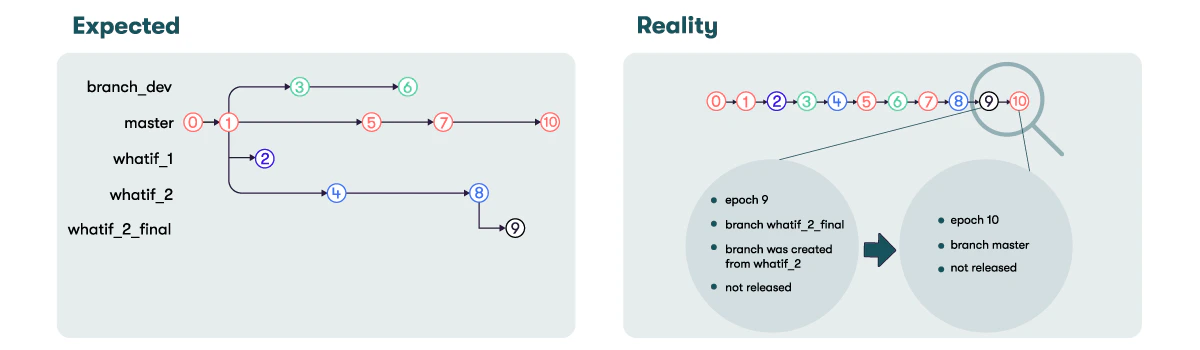
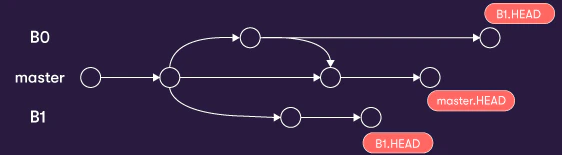 Atoti uses a Version History to link all the versions of the components using MVCC together.
This `IVersionHistory` is **always linear**, even with multiple branches.
Branch information is held in the `IHistoryNode`s of the `IVersionHistory`, which is created temporally,
commit after commit:
Atoti uses a Version History to link all the versions of the components using MVCC together.
This `IVersionHistory` is **always linear**, even with multiple branches.
Branch information is held in the `IHistoryNode`s of the `IVersionHistory`, which is created temporally,
commit after commit:
 It is possible to define, use and navigate through branches with Atoti:
* By default, there is only one branch called `master`.
* When feeding data into a datastore, each transaction can be applied from any existing branch and committed on any
other branch, creating a new one if needed.
* Once created, it is possible to continue committing data on a branch and update its head
(the latest version of a branch).
There are however operations that are limited or not possible with branches in Atoti:
* When performing a transaction, only the mentioned branch will be updated. If some data must be committed on multiple
branches, a transaction must be performed on each of the impacted branches.
* It is **not** possible to merge or rebase branches in Atoti. However, a branch can be fast-forwarded to another
branch's head using `IDatabaseService.fastForward()`.
### Creating a branch
Branches can be specified when starting transactions and using the following signatures:
```java theme={"languages":{"custom":["/engine/python-sdk/0.9/languages/pycon.tmLanguage.json"]}}
ITransactionManager.startTransactionOnBranch(String branchName, String... storeNames)
```
or
```java theme={"languages":{"custom":["/engine/python-sdk/0.9/languages/pycon.tmLanguage.json"]}}
ITransactionManager.startTransactionFromBranch(
String branchName, String parentBranchName, String... storeNames)
```
Note that the branch will only be created once the transaction is committed and the corresponding epoch is created:
```java theme={"languages":{"custom":["/engine/python-sdk/0.9/languages/pycon.tmLanguage.json"]}}
ITransactionManager.commitTransaction()
```
### Querying data on a branch
It is possible to perform a query on any version of any branch as long as the specified Epoch is still valid.
The query's results will correspond to the data as it was at the specified epoch within its corresponding branch.
For more information about the epoch policy, see the [Epoch management policy](#epoch-management-policy) section.
* The [Database REST API](../rest-api/database_rest_api) allows the user to perform branch-specific queries on the
Database. Note that the query will return data corresponding to the HEAD of the requested branch.
* The [Epoch Dimension](#epoch-dimension)'s Branch/What-if level allows the user to analyze their aggregated data set
along a scenario or another by simply changing the member of the Epoch Dimension queried by the MDX code.
### Listing and deleting branches
In order to keep track of the existing branches on an Atoti application, the following method
`IEpochManager.getBranches()` is available and returns the names of the current valid branches. The application also
exposes an MBean named `showBranches` that will print various information about branches such as the first epoch of a
branch, the latest epoch of a branch and the epoch on which a branch was created.
When a branch is no longer necessary, it can be dropped to free the memory held by the versions corresponding to its
underlying epochs and their associated versions.
It is possible to delete a branch by calling `IEpochManager.releaseBranch(String branchName)`, which is available as an
MBean named `dropBranch`.
Note that a branch can only be dropped if it does not contain the latest version. If the branch contains the latest
version, it will be dropped after the next commit.
Similarly, a branch will be effectively dropped if none of the related versions are being used.
### Performance characteristics
Thanks to the linear design of branches in Atoti, using branches does not imply an additional memory usage cost.
Moreover, there is no inherent cost incurred by the used branches count increase.
However, the current design leads to the following caveat:
> Performing a commit on a branch B will have a time cost equal to the cost of this commit in a branch-less scenario
> PLUS the cost of reverting the state of the store from its current head to the head of the branch B.
> Unfortunately, this additional cost is uncorrelated to the commit itself, but depends not only on the operations
> that occur on the datastore, but also on the order on which they occurred.
It is also worth mentioning that Indexed aggregate providers are multi-versioned components as well and therefore
support branches. As a consequence, they contribute to the memory consumption of each branch by holding pre-aggregated
data. Note that it is not the case for the Just-In-Time aggregates provider, as aggregates are computed on the fly.
In a distributed environment, the Query Cube does not have an Epoch Dimension by default. In order to support the
Epoch Dimension in a query node, it must be specified when building the cube definition. To learn more about what-if in
a distributed environment, see [What-if](../distributed/distributed_what_ifs).
## Epoch Dimension
In order to perform cross-epoch or cross-branch analysis it is possible to rely on the Epoch Dimension for MDX queries.
The Epoch Dimension is a dimension which permits the retrieval of values from previous versions of the cube and the
building of new indicators based on time.
> The Epoch Dimension can only be used in MDX queries but **NOT** inside post processors.
> The MDX function `Aggregate` cannot be used on the members of the Epoch Dimension.
The Epoch Dimension is by default composed of a hierarchy named after the dimension,
with two levels `Branch` and `Epoch`:
```text theme={"languages":{"custom":["/engine/python-sdk/0.9/languages/pycon.tmLanguage.json"]}}
Dimension: Epoch
Hierarchy: Epoch
Levels: Branch > Level
- master
+- Epoch 1
+- Epoch 3
- Branch Scenario 1
+- Epoch 2
```
The Branch level is populated by branches on which a transaction was committed.
### Configuration
In the cube description, the following line must be entered directly after the other dimensions:
```java theme={"languages":{"custom":["/engine/python-sdk/0.9/languages/pycon.tmLanguage.json"]}}
.withEpochDimension()
```
By default, the Epoch Dimension will create a dimension with a single `Branch` level available on the `Epoch` hierarchy.
The above call however returns a builder that can let the user customize further the Epoch Dimension and its two levels:
`Branch` and `Epoch`:
```java theme={"languages":{"custom":["/engine/python-sdk/0.9/languages/pycon.tmLanguage.json"]}}
.withEpochDimension()
.withinFolder("f")
.withMeasureGroups("mg")
.withEpochLevel()
.withFormatter("FFF")
.end()
```
Note that the Epoch Dimension must be defined entirely in one call of the builder, or an error message will be prompted.
### Disabling the dimension for some users
It is possible to restrict the usage of the Epoch Dimension. The dimension can be disabled for some users while the
dimension is enabled for others by attaching an MdxContext to their roles, using the following method:
```java theme={"languages":{"custom":["/engine/python-sdk/0.9/languages/pycon.tmLanguage.json"]}}
context.setDisableEpochDimension(true);
```
### Real-Time What-If Queries
A real-time query including the Epoch Dimension such as:
```
SELECT NON EMPTY [Epoch].[Epoch].[Branch].Members ON ROWS
FROM cube
```
respects the following contract regarding updates on the Epoch Dimension:
* On first registration (i.e. activating real-time), all the user visible branches should be in the result
* Upon creating a branch without changes, the query won't reflect the newly created branch
(No transaction on the branch means no update)
* A commit on any visible branch will update the query and reflect the new branch
### Misc
* Calculated members which use the Epoch Dimension can be defined:
```text theme={"languages":{"custom":["/engine/python-sdk/0.9/languages/pycon.tmLanguage.json"]}}
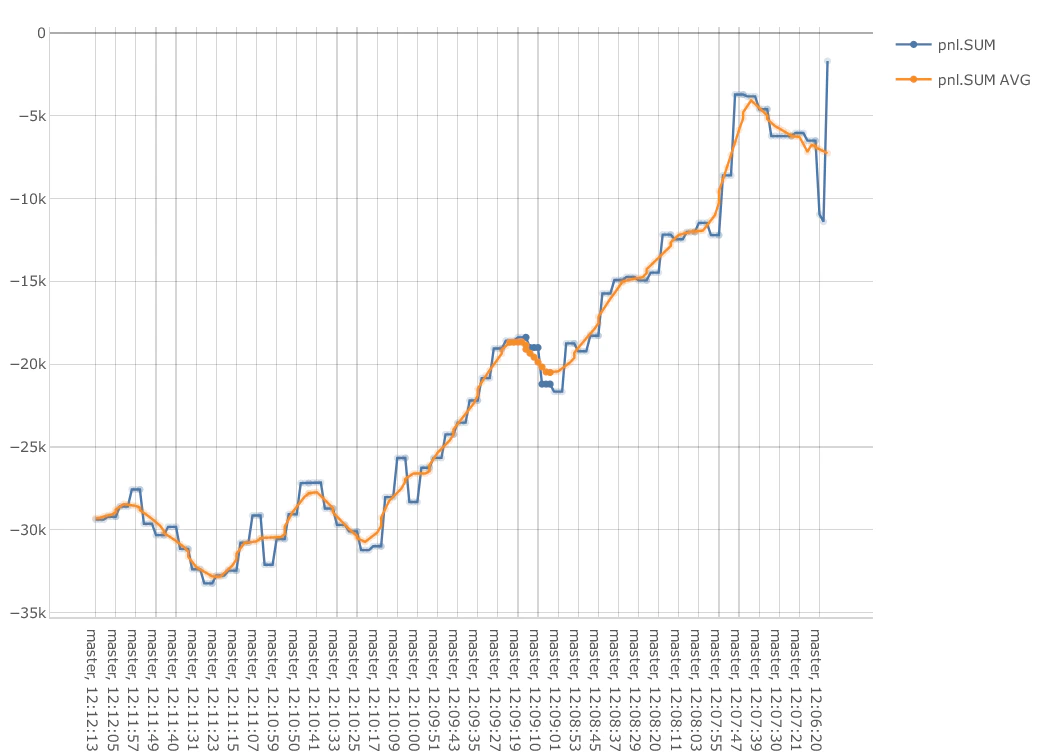
WITH MEMBER [Measures].[pnl.SUM AVG] AS
AVG([Epoch].[Epoch].CurrentMember.Lag(5):[Epoch].[Epoch].CurrentMember.Lead(5), [Measures].[pnl.SUM])
SELECT {[Measures].[pnl.SUM], [Measures].[pnl.SUM AVG]} ON COLUMNS,
[Epoch].[Epoch].[Epoch].Members ON ROWS
FROM cube
```
The previous snippet defines a Calculated Member corresponding to the rolling average of the pnl.SUM aggregated measure,
with a centered 10 epoch-wide window:
It is possible to define, use and navigate through branches with Atoti:
* By default, there is only one branch called `master`.
* When feeding data into a datastore, each transaction can be applied from any existing branch and committed on any
other branch, creating a new one if needed.
* Once created, it is possible to continue committing data on a branch and update its head
(the latest version of a branch).
There are however operations that are limited or not possible with branches in Atoti:
* When performing a transaction, only the mentioned branch will be updated. If some data must be committed on multiple
branches, a transaction must be performed on each of the impacted branches.
* It is **not** possible to merge or rebase branches in Atoti. However, a branch can be fast-forwarded to another
branch's head using `IDatabaseService.fastForward()`.
### Creating a branch
Branches can be specified when starting transactions and using the following signatures:
```java theme={"languages":{"custom":["/engine/python-sdk/0.9/languages/pycon.tmLanguage.json"]}}
ITransactionManager.startTransactionOnBranch(String branchName, String... storeNames)
```
or
```java theme={"languages":{"custom":["/engine/python-sdk/0.9/languages/pycon.tmLanguage.json"]}}
ITransactionManager.startTransactionFromBranch(
String branchName, String parentBranchName, String... storeNames)
```
Note that the branch will only be created once the transaction is committed and the corresponding epoch is created:
```java theme={"languages":{"custom":["/engine/python-sdk/0.9/languages/pycon.tmLanguage.json"]}}
ITransactionManager.commitTransaction()
```
### Querying data on a branch
It is possible to perform a query on any version of any branch as long as the specified Epoch is still valid.
The query's results will correspond to the data as it was at the specified epoch within its corresponding branch.
For more information about the epoch policy, see the [Epoch management policy](#epoch-management-policy) section.
* The [Database REST API](../rest-api/database_rest_api) allows the user to perform branch-specific queries on the
Database. Note that the query will return data corresponding to the HEAD of the requested branch.
* The [Epoch Dimension](#epoch-dimension)'s Branch/What-if level allows the user to analyze their aggregated data set
along a scenario or another by simply changing the member of the Epoch Dimension queried by the MDX code.
### Listing and deleting branches
In order to keep track of the existing branches on an Atoti application, the following method
`IEpochManager.getBranches()` is available and returns the names of the current valid branches. The application also
exposes an MBean named `showBranches` that will print various information about branches such as the first epoch of a
branch, the latest epoch of a branch and the epoch on which a branch was created.
When a branch is no longer necessary, it can be dropped to free the memory held by the versions corresponding to its
underlying epochs and their associated versions.
It is possible to delete a branch by calling `IEpochManager.releaseBranch(String branchName)`, which is available as an
MBean named `dropBranch`.
Note that a branch can only be dropped if it does not contain the latest version. If the branch contains the latest
version, it will be dropped after the next commit.
Similarly, a branch will be effectively dropped if none of the related versions are being used.
### Performance characteristics
Thanks to the linear design of branches in Atoti, using branches does not imply an additional memory usage cost.
Moreover, there is no inherent cost incurred by the used branches count increase.
However, the current design leads to the following caveat:
> Performing a commit on a branch B will have a time cost equal to the cost of this commit in a branch-less scenario
> PLUS the cost of reverting the state of the store from its current head to the head of the branch B.
> Unfortunately, this additional cost is uncorrelated to the commit itself, but depends not only on the operations
> that occur on the datastore, but also on the order on which they occurred.
It is also worth mentioning that Indexed aggregate providers are multi-versioned components as well and therefore
support branches. As a consequence, they contribute to the memory consumption of each branch by holding pre-aggregated
data. Note that it is not the case for the Just-In-Time aggregates provider, as aggregates are computed on the fly.
In a distributed environment, the Query Cube does not have an Epoch Dimension by default. In order to support the
Epoch Dimension in a query node, it must be specified when building the cube definition. To learn more about what-if in
a distributed environment, see [What-if](../distributed/distributed_what_ifs).
## Epoch Dimension
In order to perform cross-epoch or cross-branch analysis it is possible to rely on the Epoch Dimension for MDX queries.
The Epoch Dimension is a dimension which permits the retrieval of values from previous versions of the cube and the
building of new indicators based on time.
> The Epoch Dimension can only be used in MDX queries but **NOT** inside post processors.
> The MDX function `Aggregate` cannot be used on the members of the Epoch Dimension.
The Epoch Dimension is by default composed of a hierarchy named after the dimension,
with two levels `Branch` and `Epoch`:
```text theme={"languages":{"custom":["/engine/python-sdk/0.9/languages/pycon.tmLanguage.json"]}}
Dimension: Epoch
Hierarchy: Epoch
Levels: Branch > Level
- master
+- Epoch 1
+- Epoch 3
- Branch Scenario 1
+- Epoch 2
```
The Branch level is populated by branches on which a transaction was committed.
### Configuration
In the cube description, the following line must be entered directly after the other dimensions:
```java theme={"languages":{"custom":["/engine/python-sdk/0.9/languages/pycon.tmLanguage.json"]}}
.withEpochDimension()
```
By default, the Epoch Dimension will create a dimension with a single `Branch` level available on the `Epoch` hierarchy.
The above call however returns a builder that can let the user customize further the Epoch Dimension and its two levels:
`Branch` and `Epoch`:
```java theme={"languages":{"custom":["/engine/python-sdk/0.9/languages/pycon.tmLanguage.json"]}}
.withEpochDimension()
.withinFolder("f")
.withMeasureGroups("mg")
.withEpochLevel()
.withFormatter("FFF")
.end()
```
Note that the Epoch Dimension must be defined entirely in one call of the builder, or an error message will be prompted.
### Disabling the dimension for some users
It is possible to restrict the usage of the Epoch Dimension. The dimension can be disabled for some users while the
dimension is enabled for others by attaching an MdxContext to their roles, using the following method:
```java theme={"languages":{"custom":["/engine/python-sdk/0.9/languages/pycon.tmLanguage.json"]}}
context.setDisableEpochDimension(true);
```
### Real-Time What-If Queries
A real-time query including the Epoch Dimension such as:
```
SELECT NON EMPTY [Epoch].[Epoch].[Branch].Members ON ROWS
FROM cube
```
respects the following contract regarding updates on the Epoch Dimension:
* On first registration (i.e. activating real-time), all the user visible branches should be in the result
* Upon creating a branch without changes, the query won't reflect the newly created branch
(No transaction on the branch means no update)
* A commit on any visible branch will update the query and reflect the new branch
### Misc
* Calculated members which use the Epoch Dimension can be defined:
```text theme={"languages":{"custom":["/engine/python-sdk/0.9/languages/pycon.tmLanguage.json"]}}
WITH MEMBER [Measures].[pnl.SUM AVG] AS
AVG([Epoch].[Epoch].CurrentMember.Lag(5):[Epoch].[Epoch].CurrentMember.Lead(5), [Measures].[pnl.SUM])
SELECT {[Measures].[pnl.SUM], [Measures].[pnl.SUM AVG]} ON COLUMNS,
[Epoch].[Epoch].[Epoch].Members ON ROWS
FROM cube
```
The previous snippet defines a Calculated Member corresponding to the rolling average of the pnl.SUM aggregated measure,
with a centered 10 epoch-wide window:
 * The members that are available in the dimension depend on the Epoch Management Policy. The released epochs are not
available in the dimension.
* The name of the Epoch Dimension can be changed to "Branch" (useful if the epoch level is disabled) by setting the
following property:
```properties theme={"languages":{"custom":["/engine/python-sdk/0.9/languages/pycon.tmLanguage.json"]}}
activeviam.mdx.epoch.dimension.legacyName=false
```
This will impact the final MDX send to the server. To change the name of this hierarchy and its levels according to user
domain names, use the [Internationalization feature](../configuration/internationalization).
### Efficient queries and Examples
#### Efficient queries
The filters on the Epoch Dimension must be performed inside sub-selects.
The 2 following queries will return the same results (i.e. the values of pnl.SUM for 5 epochs):
**Inefficient Query:**
```text theme={"languages":{"custom":["/engine/python-sdk/0.9/languages/pycon.tmLanguage.json"]}}
SELECT [Measures].[pnl.SUM] ON COLUMNS,
Subset([Epoch].[Epoch].[Epoch].Members, 0, 5) ON ROWS
FROM cube
```
**Efficient Query:**
```text theme={"languages":{"custom":["/engine/python-sdk/0.9/languages/pycon.tmLanguage.json"]}}
SELECT [Measures].[pnl.SUM] ON COLUMNS,
[Epoch].[Epoch].[Epoch].Members ON ROWS
FROM (SELECT Subset([Epoch].[Epoch].[Epoch].Members, 0, 5) ON 0
FROM cube)
```
The MDX engine evaluates the cells before building the axes. Because of this behavior, the MDX engine will, for the
first query, retrieve the values of pnl.SUM on **all the available versions of the cube** and then only display 5 of
them.
The second query creates a restriction on the Epoch Dimension due to a sub-select. As the sub-selects are computed
before the cells of the pivot table, the MDX engine will only retrieve the values of pnl.SUM for the 5 selected epochs.
#### Queries and Real-Time
With the Epoch Dimension, the user has the ability to look in the past.
Some of the queries will receive real time updates if the `AllMember` member is not filtered out by the sub-select
filtering the Epochs.
Here are some examples:
* The members that are available in the dimension depend on the Epoch Management Policy. The released epochs are not
available in the dimension.
* The name of the Epoch Dimension can be changed to "Branch" (useful if the epoch level is disabled) by setting the
following property:
```properties theme={"languages":{"custom":["/engine/python-sdk/0.9/languages/pycon.tmLanguage.json"]}}
activeviam.mdx.epoch.dimension.legacyName=false
```
This will impact the final MDX send to the server. To change the name of this hierarchy and its levels according to user
domain names, use the [Internationalization feature](../configuration/internationalization).
### Efficient queries and Examples
#### Efficient queries
The filters on the Epoch Dimension must be performed inside sub-selects.
The 2 following queries will return the same results (i.e. the values of pnl.SUM for 5 epochs):
**Inefficient Query:**
```text theme={"languages":{"custom":["/engine/python-sdk/0.9/languages/pycon.tmLanguage.json"]}}
SELECT [Measures].[pnl.SUM] ON COLUMNS,
Subset([Epoch].[Epoch].[Epoch].Members, 0, 5) ON ROWS
FROM cube
```
**Efficient Query:**
```text theme={"languages":{"custom":["/engine/python-sdk/0.9/languages/pycon.tmLanguage.json"]}}
SELECT [Measures].[pnl.SUM] ON COLUMNS,
[Epoch].[Epoch].[Epoch].Members ON ROWS
FROM (SELECT Subset([Epoch].[Epoch].[Epoch].Members, 0, 5) ON 0
FROM cube)
```
The MDX engine evaluates the cells before building the axes. Because of this behavior, the MDX engine will, for the
first query, retrieve the values of pnl.SUM on **all the available versions of the cube** and then only display 5 of
them.
The second query creates a restriction on the Epoch Dimension due to a sub-select. As the sub-selects are computed
before the cells of the pivot table, the MDX engine will only retrieve the values of pnl.SUM for the 5 selected epochs.
#### Queries and Real-Time
With the Epoch Dimension, the user has the ability to look in the past.
Some of the queries will receive real time updates if the `AllMember` member is not filtered out by the sub-select
filtering the Epochs.
Here are some examples:
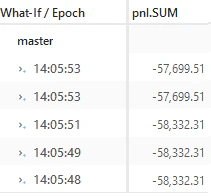
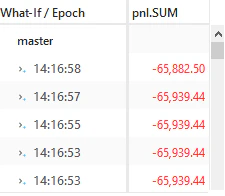
The following query will receive real time updates.
One new row will appear for each new version:
One new row will appear for each new version:
SELECT \[Measures].\[pnl.SUM] ON COLUMNS,
\[Epoch].\[Epoch].\[Epoch].Members ON ROWS
FROM cube
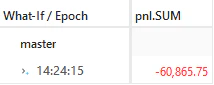
As this query aims to display the value of Epoch 20 from the branch master,
this query will not receive real time updates.
this query will not receive real time updates.
SELECT \[Measures].\[pnl.SUM] ON COLUMNS,
\[Epoch].\[Epoch].\[Epoch].Members ON ROWS
FROM (SELECT \[Epoch].\[Epoch].\[Branch].\[master].\[20] ON 0
FROM cube
This query is like the previous one but uses a subselect to choose 2 epochs.
SELECT \[Measures].\[pnl.SUM] ON COLUMNS,
\[Epoch].\[Epoch].\[Epoch].Members ON ROWS
FROM (SELECT \{\[Epoch].\[Epoch].\[Epoch].\[10],
\[Epoch].\[Epoch].\[Epoch].\[12]} ON 0
FROM cube)
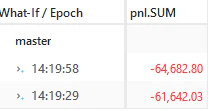
This query that displays the five oldest epochs will never be updated because the MDX engine cannot register continuous queries on past Epochs.
SELECT \[Measures].\[pnl.SUM] ON COLUMNS,
\[Epoch].\[Epoch].\[Epoch].Members ON ROWS
FROM (SELECT Tail(\[Epoch].\[Epoch].\[Epoch].Members, 5) ON 0
FROM cube)
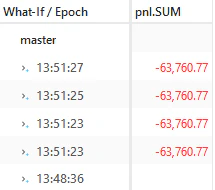
This query will always display the five most recent epochs.
SELECT \[Measures].\[pnl.SUM] ON COLUMNS,
\[Epoch].\[Epoch].\[Epoch].Members ON ROWS
FROM ( SELECT Head(\[Epoch].\[Epoch].\[Epoch].Members, 5) ON 0
FROM cube)